
Marion Release Supervision Types
Parole and probation both allow a person to live in the community under rules, but they arise from different decisions. In Tennessee, the independent Board of Parole conducts hearings and decides whether an eligible state prisoner may be paroled. Tennessee Department of Correction Community Supervision then manages parole and many felony probation cases. A Marion County court imposes probation through its judgment or later order. That court record remains important when a county jail entry has already left the short release window.
Release from confinement and discharge from supervision are separate events. A Marion County person on parole has left confinement but is serving the supervised part of a state sentence. Someone on probation is following a court-ordered community sentence, which may have begun without prison or after a custodial term. An inactive TDOC record can be a useful sign that supervision ended, but the full record and effective date must still be read.
| Point | Parole | Probation |
|---|---|---|
| Who orders it | Tennessee Board of Parole after eligibility and review | The sentencing court |
| Relation to custody | Usually follows prison confinement | May replace or follow confinement |
| Public verification | TDOC FOIL status, Board records, and Field Services | TDOC FOIL when covered, the court order, and Field Services |
| End point | Discharge, sentence expiration, or another lawful termination | Completion or court-ordered termination |
- Parole
- Conditional release from confinement while part of a sentence remains under supervision.
- Probation
- A court-ordered community sentence governed by stated terms.
- Discharge
- The formal end of the relevant custody or supervision obligation.
- Revocation
- An official action that cancels community release after a proven violation process.
Check Marion Post-Release Supervision
The best public starting point for a named felony offender is TDOC Felony Offender Information Lookup, known as FOIL. TDOC states that it covers current and former felony offenders and may show incarceration, parole, probation, or inactive status. It may also show location, sentence, hearing, and release information. FOIL does not cover every person booked into the Marion County Jail. A local misdemeanor, dismissal, or bond release may never create a TDOC record.
Use several sources when the result matters. The state record identifies TDOC supervision. The Marion County court file explains the probation order and any later revocation or satisfaction entry. The jail release record confirms physical exit from county custody. The full Marion County search and release-record path is available on the released-inmate search home page.
- Search FOIL by committed name or TDOC number. Compare date of birth and other identifiers before opening a record.
- Read the exact status. Do not translate parole, probation, or inactive into a broader claim than TDOC makes.
- Review all sentence rows, release information, location, and any parole-hearing status that appears.
- Obtain the Marion County judgment or supervision order when the case began in local court.
- Use the official TDOC field-office directory to route a lawful status or office question.
- Request the written Board decision or TDOC record when a durable document is needed.
For a county jail event, look for the iSOMS Release Date and Released marker, then ask whether the event was a community release or transfer. State parole status does not replace that county proof. Likewise, a court order may authorize release before jail processing is complete.
Note: A no-result in FOIL can reflect the system's limited felony scope, a name mismatch, or a record affected by lawful restriction.
Marion Supervision Office in Jasper
Marion County has a concrete local route for supervision questions. TDOC District 30 lists its Grundy/Marion field office in Jasper. The office can provide routing, office confirmation, and instructions that staff may lawfully share. It should not be treated as an open source for private case notes or a person's daily movements.
TDOC Grundy/Marion Field Office
Tennessee Department of Correction, District 30
5 North Oak Street, Suite A
Jasper, TN 37347
Phone: 423-942-9290
Fax: 423-942-1320
The TDOC directory also identifies a district office in Chattanooga serving Bledsoe, Hamilton, Marion, Rhea, and Sequatchie counties. Start with Jasper for a Marion supervision matter. If the local office redirects the call, follow the current agency instruction rather than assuming which officer or district owns the case.
The sheriff's contact page separately lists state probation numbers, including 423-942-9290 and 423-942-9292. The TDOC field-office directory is the preferred source because it is maintained by the supervising agency.
The official directory view shows how Tennessee routes post-release supervision by field office. Open the TDOC field-office source before relying on an office listing.
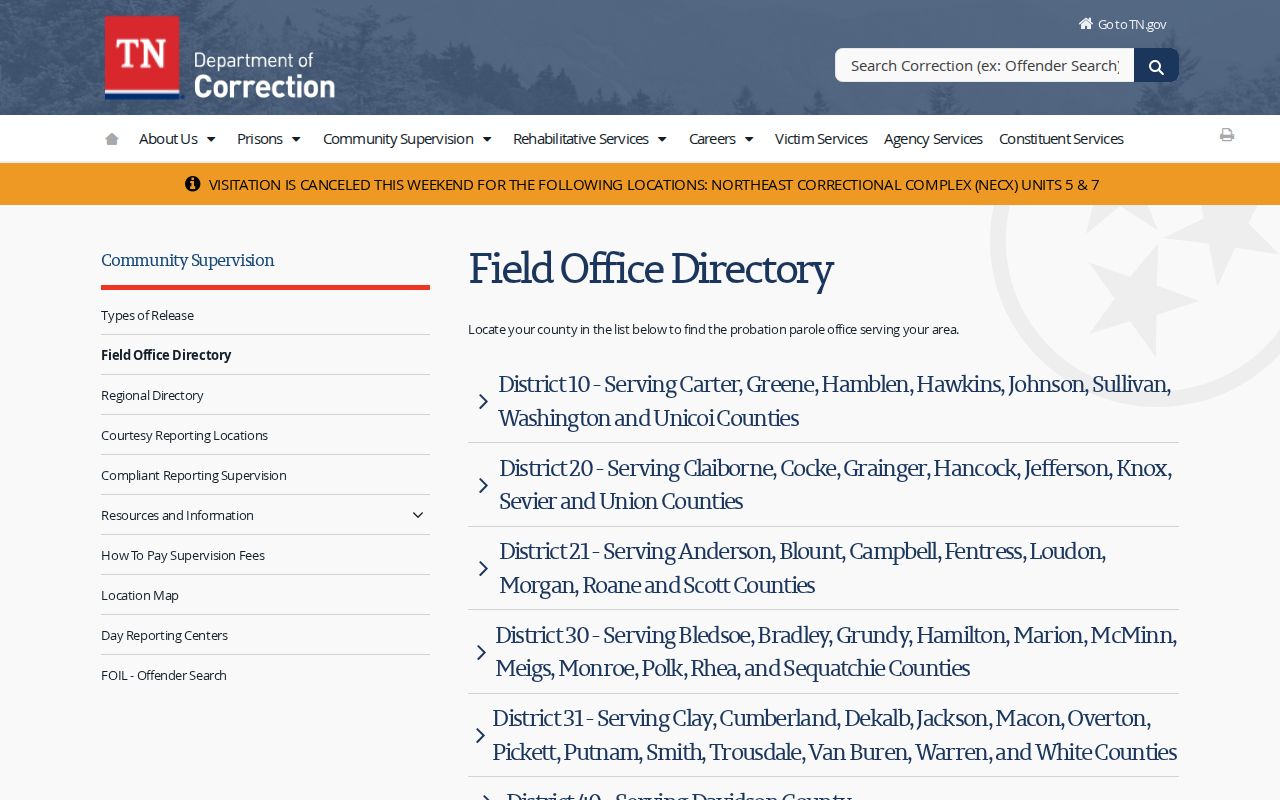
The screenshot supports the Jasper routing path, while the live directory should control if state office assignments later change.
Marion Parole Hearing Records
A hearing calendar is a planning record, not an exit record. The Board's hearing page says prison and county-jail schedules are updated weekly, normally on Monday or Tuesday after a Monday holiday. Last-minute changes can occur. A listed name and hearing date show only that a proceeding is planned.
Hearing officers gather information and make nonbinding recommendations. Board members then adopt, change, or reject those recommendations under the governing voting rules. Outcomes can include grant, denial, deferral, revocation, rescission, or reinstatement. Even a grant can depend on release planning and conditions, and it can be rescinded before physical release. FOIL may show hearing status for an individual, while a final written decision can be requested from the Board.
The official page illustrates the state schedule and update process. Check the current Board hearing notice near the planned date.
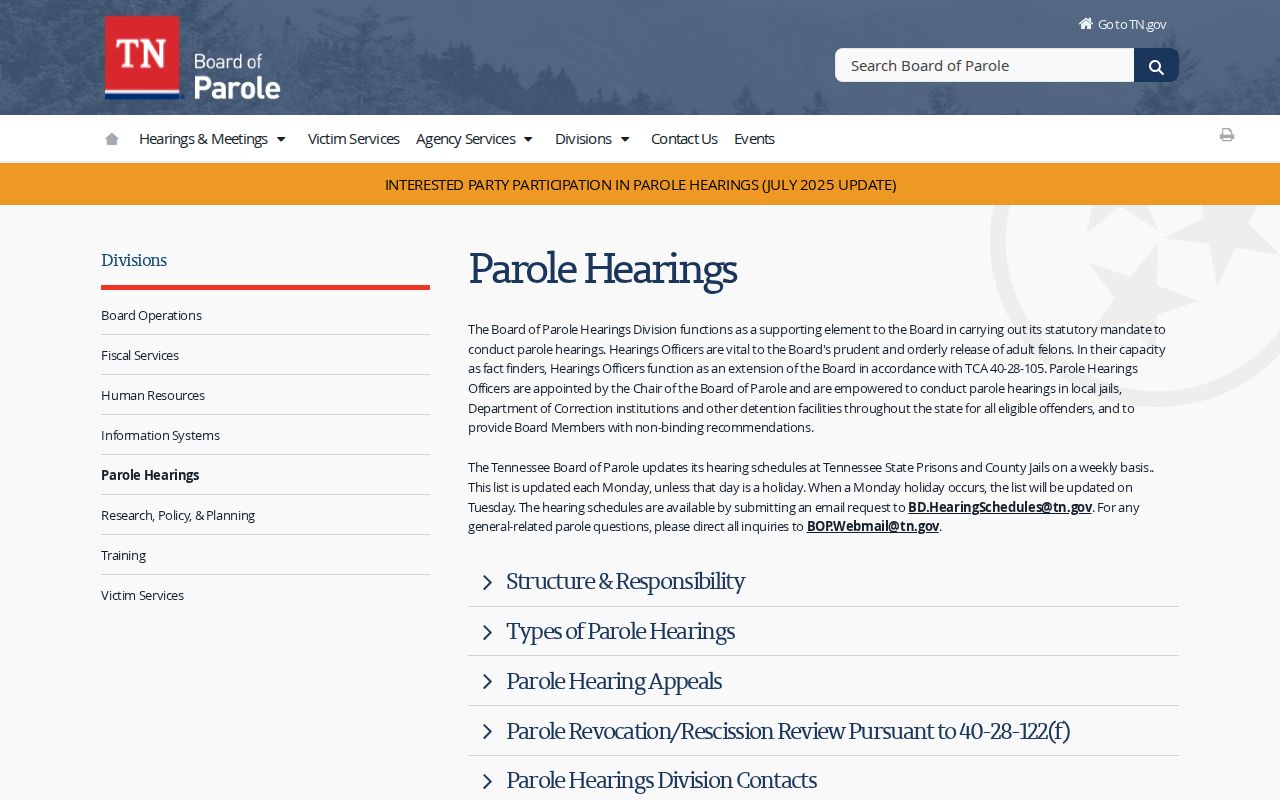
Use that schedule to track the proceeding, then verify the decision and the later custody event through the proper record.
Note: Board schedules change, so confirm a Marion County hearing near its date and never equate eligibility with release.
Marion Supervision and Warrants
Conditions are the rules attached to release. They can address reporting, approved residence, travel, treatment, fees, contact, or other case-specific duties. The controlling terms come from the order and supervising agency, not a generic list. A violation allegation can lead to a hearing, a change in conditions, or revocation, but the allegation itself is not the final decision.
An absconder is a supervised person officially alleged to have stopped reporting or avoided supervision. No current statewide public probation-absconder list or Marion County absconder list was verified in the research. FOIL may show a warrant or violation note in a particular record, but that field should not be promised for every person. County warrants, parole warrants, and probation violations are distinct records.
A parole or probation label does not establish compliance. It also does not justify guessing where someone is. Confirm a current warrant through the responsible court or agency. For a state supervision routing question, use TDOC Field Services. For a local probation order or revocation entry, use the Marion County clerk holding the criminal docket.
Why Marion's Jasper Office Matters
TDOC's District 30 Grundy/Marion office sits in the same North Oak Street justice-center area as the jail and courts. That proximity is useful, but the records remain separate. Jail staff control the booking and physical-release record. The clerk controls the judgment and probation order. TDOC controls the state supervision file. The Board controls its parole decision record.
This distinction prevents a common mistake. Walking out of the Marion County Jail does not establish that all state or court obligations ended. A person may report to TDOC, follow probation terms, wait on a separate case, or be transferred to another custodian. Ask each office only for the record it owns. The local TDOC office is a real check-in and routing point, not a substitute for the court or sheriff.
TDOC's Community Resource Centers and Day Reporting Centers may help people on community supervision and those released after sentence expiration. The state resource page says access can occur through officer referral or direct contact. Verify the nearest current location before travel because the research did not establish a Marion site.
Marion Supervision Discharge Records
Supervision ends through a formal event, not merely through the passage of a date shown on an old record. The end may be sentence expiration, discharge, court termination, or another authorized disposition. Mandatory reentry supervision under T.C.A. §40-35-506 can place an eligible person in the community for the final period or add a post-expiration supervision period under the statute. That status remains supervised release.
Read FOIL's exact status and effective date. Then obtain the source document when proof matters. For parole, the Board decision and TDOC discharge record address different parts of the history. For probation, the court docket may hold a satisfaction, termination, or revocation entry. An archived TDOC request may supply a durable record after the public summary changes.
The process can be expressed simply: custody, conditional release, community supervision, then formal discharge. Each arrow requires its own source. A Marion jail Release Date proves the county event. It does not, by itself, prove the last step.
When the public summary is not enough, request the record from the office that made it. TDOC archived records can preserve sentence and release material after a public display changes. The Board holds its final parole decision. The Marion clerk holds the probation judgment and later court entries. A focused request should identify the person, case or TDOC number, and the exact discharge document sought. Include a useful date range and ask for the existing record, not a new analysis. That approach avoids asking one office to explain another agency's record and produces a clearer supervision timeline.